What is a platform lift? Step, vertical and inclined, explained
A platform lift carries a person, standing or in a wheelchair, on a platform rather than in an enclosed car, over a rise that is usually short: a few steps, a raised ground floor, or a flight of stairs. There are three kinds. A step lift rises straight up beside a few steps; a vertical platform lift rises further, to a raised entrance or a mezzanine; an inclined platform lift runs up a staircase on a rail. All three are used in homes and in buildings open to the public.
Last reviewed against its sources: 13 November 2026. Each figure links to the page it was read on.
Step lifts: the short rise
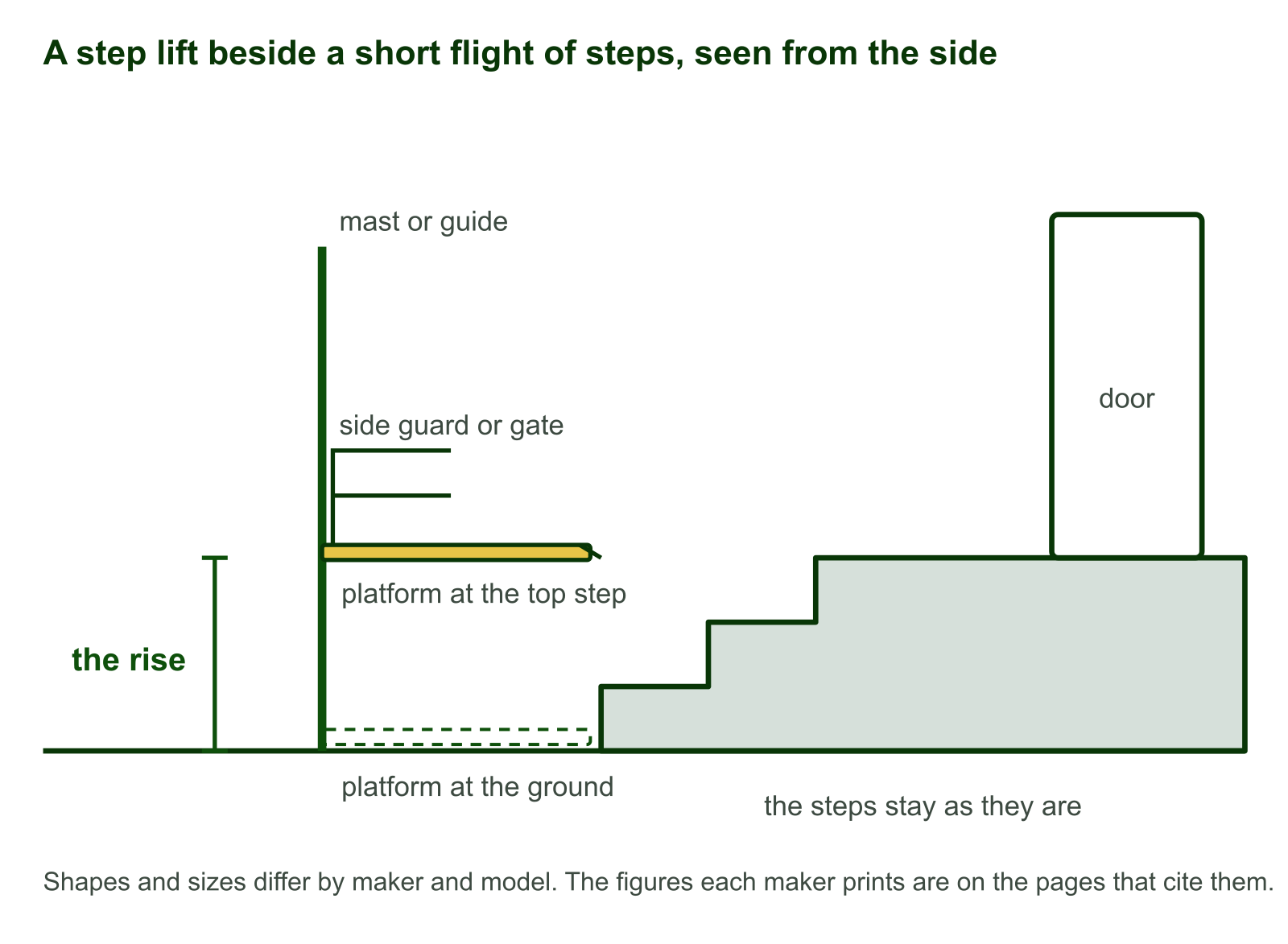
A step lift is the smallest kind: an open platform with side guards or gates that rises beside the steps at a front door, a split level or a shop entrance, and stops level with the top step. The person rides it standing or in a wheelchair, holding a control. Because it rises straight up, it needs level ground beside or in front of the steps rather than space along them. Lifts for a few steps is about choosing one by the number of steps.
Vertical platform lifts: higher, sometimes enclosed
A vertical platform lift works the same way over a greater height: up to a raised ground floor, a mezzanine in a shop, or a change of level in a public building. Over a greater height the sides need to be higher, and some models run inside an enclosure or a shaft of their own. Vertical platform lifts covers where they are used.
Inclined platform lifts: up the stairs
An inclined platform lift carries a wheelchair on a folding platform along a rail fixed to the wall or the stairs, so it uses the staircase itself rather than space beside it. It suits a flight too long for a step lift, where there is no room for a vertical lift. Platform lifts for stairs sets out what makers print for them.
How makers describe them
Otis UK describes open platform lifts as generally serving shorter travels, with an open platform and safety arms or gates protected by a surrounding barrier or small enclosure, and says they need less headroom and pit depth than a traditional passenger lift (Otis UK, checked 13 November 2026). Wessex Lifts says its PLG7 inclined lift bridges the gap between stairlifts and platform lifts (Wessex Lifts, checked 13 November 2026).
The standards they are built to
Platform lifts have their own British Standards, separate from those for ordinary passenger lifts. These are the titles and scopes as BSI’s own pages give them:
- BSI Knowledge lists BS 6440:2011, Powered vertical lifting platforms having non-enclosed or partially enclosed liftways intended for use by persons with impaired mobility, as Current (published 31 Aug 2011); it specifies requirements for the design, manufacture, installation, testing, maintenance and dismantling of new permanently installed electrically powered vertical lifting platforms travelling between two predefined levels, including scissor mechanisms. (BSI, checked 13 November 2026)
- BSI Knowledge shows BS EN 81-41:2010 (vertical lifting platforms intended for use by persons with impaired mobility), published 31 Jan 2011, as Withdrawn on 9 Dec 2024. (BSI, checked 13 November 2026)
- BSI Knowledge lists BS EN 81-41:2024 (vertical lifting platforms intended for use by persons with impaired mobility) as Current, published 31 Dec 2024, covering electrically powered vertical lifting platforms affixed to a building with enclosed liftways, a rated speed not greater than 0,15 m/s and a carrier that is not completely enclosed; the page read is the tracked-changes ('TC') edition. (BSI, checked 13 November 2026)
- BSI Knowledge lists BS EN 81-40:2020 (stairlifts and inclined lifting platforms intended for persons with impaired mobility) as Current, Under Review, published 30 Sep 2020, covering chair lifts, standing platforms and wheelchair platforms moving in an inclined plane; it supersedes the withdrawn 2008 edition. (BSI, checked 13 November 2026)
A standard is something to ask a seller about, not something to check yourself: ask which standard the model is built to and for its declaration of conformity.
Where the building regulations mention them
The government’s guidance on access to buildings other than homes, Approved Document M volume 2, deals with the vertical and the inclined kinds. It calls a passenger lift the most suitable way between storeys and allows a vertical lifting platform where one cannot be accommodated (Approved Document M, checked 13 November 2026); it says lifting platforms are for wheelchair users, people with impaired mobility and their companions, and travel slowly on continuous pressure controls (Approved Document M, checked 13 November 2026); and it allows a wheelchair platform stairlift, its name for the inclined kind, only in exceptional circumstances in an existing building (Approved Document M, checked 13 November 2026). Volume 1, for dwellings, mentions lifting platforms only as lifts between floors in homes built to be wheelchair accessible (Approved Document M, checked 13 November 2026). The rules page sets out each source in turn.
The sizes makers print
Each model has a printed maximum rise and a platform size. Here is what the makers whose pages we could read print, each as that publisher’s own figure.
| Maker or seller, model | Kind | Most it is printed to climb | Printed size | Rated load | Source |
|---|---|---|---|---|---|
| Terry Lifts, TSL 500 step lift | step lift | 500mm | 800mm (internal platform width) | 250kg | (Terry Lifts, checked 13 November 2026) |
| Wessex Lifts, SP step lift (SP500) | step lift | 500mm | 1310L x 980W (footprint) | 250 kg | (Wessex Lifts, checked 13 November 2026) (Wessex Lifts brochure, checked 13 November 2026) |
| New Lift Solutions, Classic 1m step lift | step lift | Up to 1 metre | 980 x 1810mm (external size, smallest platform) | 280kg | (New Lift Solutions, checked 13 November 2026) |
| Stannah Lifts, Lowriser step lift | step lift | 1m | – | 300kg | (Stannah Lifts, checked 13 November 2026) |
| Terry Lifts, TSL 1000 step lift | step lift | 1000 mm | 800mm or 900mm (internal platform width) | 250kg | (Terry Lifts, checked 13 November 2026) |
| Terry Lifts, TSL 1100W step lift | step lift | 1000 mm or 920 mm when in a pit | 1100mm (internal platform width) | 385kg | (Terry Lifts, checked 13 November 2026) |
| Wessex Lifts, LR platform lift (LR800) | vertical platform lift | 1000mm | 1491 x 1004 (footprint) | 300kg | (Wessex Lifts, checked 13 November 2026) |
| Adapt Life, Elevate Echo vertical platform lift | vertical platform lift | 1050 mm | 1030 mm x 1330 mm (sub-platform) | 225 kg | (Adapt Life, checked 13 November 2026) |
| New Lift Solutions, EasyLift | step lift | 70-1250 mm | – | 400 kg / 2 pers. | (New Lift Solutions, checked 13 November 2026) |
| Stannah Lifts, Lowriser 2 step lift | step lift | 2m | – | 300kg | (Stannah Lifts, checked 13 November 2026) |
| Wessex Lifts, Liberty Open platform lift | vertical platform lift | 2000mm | 1520 x 1240 (lift size, smallest) | 300kg | (Wessex Lifts, checked 13 November 2026) |
| Gartec, UnaPorte platform step lift | step lift | 600 mm – 3000 mm | 1333 mm × 1690 mm (space required) | 385 kg | (Gartec, checked 13 November 2026) |
| Terry Lifts, Melody 3 platform lift | vertical platform lift | 3m (public access restricted to 2m) | 900mm x 1400mm (platform, standard) | 500kg up to 2m travel or 440kg up to 3m | (Terry Lifts, checked 13 November 2026) |
| Adapt Life, Elevate Glide | inclined platform lift | – | 800 mm wide × 1000 mm long (platform) | 225 kg | (Adapt Life, checked 13 November 2026) |
| Gartec, Ascendor PLG7 platform stairlift | inclined platform lift | – | 800 × 650 mm (platform, smallest of 13 sizes) | 225 kg | (Gartec, checked 13 November 2026) |
| Wessex Lifts, PLG7 incline platform stairlift | inclined platform lift | 3m of travel along the stairs | – | 225kg standard - 300kg optional | (Wessex Lifts, checked 13 November 2026) |
A dash means the page we read gave no figure for that column in a form we could quote.
At home and at work
Questions about platform lifts
A platform lift carries a person, often in a wheelchair, on a platform, usually slowly and over a short rise, and is built to its own product standards. A passenger lift has an enclosed car in a shaft, like the lifts in offices. This site covers platform lifts only.
Yes. A step lift is the short-rise kind: a platform that rises beside a few steps at a door, a split level or a shop entrance.
An inclined platform lift can: its platform runs up the flight on a rail, carrying a wheelchair user. A step lift or a vertical platform lift rises straight up beside the steps instead.
No. Many people who can stand but cannot manage steps use one, standing on the platform and holding the rail. Makers print the size and the load each model takes.
Read for this page
The pages below are grouped by the day each was last read, newest first. Seen one change? Say which on the contact page, and the corrections page shows what happens next.
- Read on 13 November 2026: BSI Knowledge, BS 6440:2011 (knowledge.bsigroup.com); BSI Knowledge, BS EN 81-40:2020 (knowledge.bsigroup.com); BSI Knowledge, BS EN 81-41:2010 (knowledge.bsigroup.com); BSI Knowledge, BS EN 81-41:2024 - TC (knowledge.bsigroup.com); HM Government, Approved Document M volume 1: dwellings, 2015 edition incorporating 2016 amendments (assets.publishing.service.gov.uk); HM Government, Approved Document M volume 2: buildings other than dwellings, version incorporating 2024 amendments (assets.publishing.service.gov.uk); Otis UK, What is a Platform Lift? (otis.com) and Wessex Lifts, The Wessex PLG7 Incline Platform Stairlift (wessexlifts.co.uk).