Wheelchair platform lifts for the home: front doors and split levels
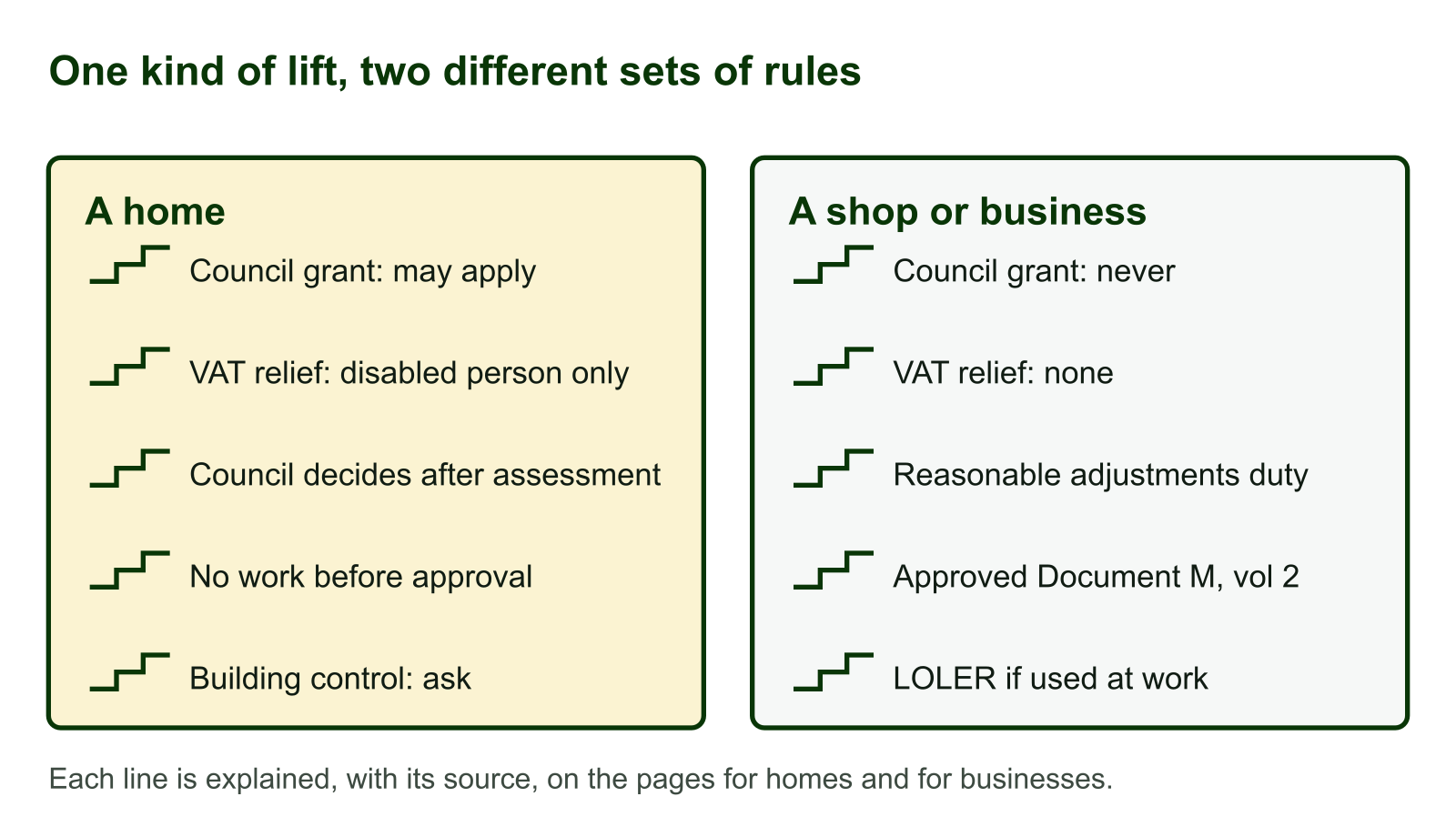
A wheelchair platform lift for a home, usually called a step lift, carries a person, sitting in a wheelchair or standing, up the few steps at a front or back door, or between two levels inside the house. The platform rises beside the steps, so the steps stay as they are. For a disabled person’s home, the council’s Disabled Facilities Grant may help after an assessment (GOV.UK, checked 12 November 2026), and VAT relief may apply on a written declaration (GOV.UK, checked 12 November 2026).
Last reviewed against its sources: 13 November 2026. Each figure links to the page it was read on.
What to expect for a home
- An assessment firstFor the grant, the council may send an occupational therapist or a trained assessor to see what is needed (GOV.UK, checked 12 November 2026).
- A means test, oftenIn England the grant usually depends on income and on savings over £6,000 (GOV.UK, checked 12 November 2026).
- Nothing before approvalStart or order the work before the council approves it and you might get no grant at all (GOV.UK, checked 12 November 2026).
- VAT on a declarationA disabled buyer signs a declaration and the seller applies the relief; nothing is reclaimed later (HMRC Notice 701/7, checked 13 November 2026).
Get a step lift quote for a home
Say how many steps there are, whether it is for a home or a business, and give the postcode. Your details come to SEO Dons Ltd, which publishes Steplift.uk, and we reply by email. Asking binds you to nothing.
What happens next
- SEO Dons Ltd, which publishes Steplift.uk, receives what you send by email.
- We look at the steps and the kind of lift you describe, then reply by email.
- You agree to nothing until you sign a firm’s written quote; for a home with a council grant in view, the council approves the work first.
Where a step lift goes in a home
The front door. The most common place: two, three or four steps from the path up to the door, with a step or a sill at the threshold as well. The lift stands beside the steps on level ground and lifts the platform to the top step, where the person rolls or walks through the door. Measure from the path to the top of the threshold, not just to the top step, if there is a lip to clear.
The back door or the garden. Many houses have more steps at the back than at the front, down to a patio or a sloping garden. A lift there may be the only level way out to a garden or a car, and it is outdoors, with everything that means for weather and drainage; the outdoor step lifts page covers that.
A split level inside. Some homes have a few steps between rooms: a sunken lounge, a kitchen extension a step or two down, a half landing to a bedroom. A step lift there stays indoors and dry, but it needs room on both levels for the platform and for turning a wheelchair.
A raised ground floor. Where the steps up to the door are many, a short-rise step lift may not reach. Taller vertical platform lifts, or an inclined platform lift that runs up the steps themselves, are the usual alternatives; lifts for a few steps sets out which kind suits how many steps.
What the person using it needs
Start from the person rather than the lift. Does a wheelchair go on the platform, and if so how big is it, with its footrests? Does someone travel alongside? Can the person press and hold a button, or would a control on a lead suit better? Is the lift for every day, or for getting out to an appointment twice a week? A good supplier asks these questions before naming a model. An occupational therapist, if the council sends one, will ask them too.
Then come the two measurements: the height to climb and the space on level ground. The rise and space checker adds the height up and sets both beside what makers print.
What makers print for these lifts
Each row is one maker’s or seller’s own figure for a step lift, read on its own page on the date shown; models their makers describe for public or commercial buildings only are left out. None is a promise for your steps.
| Maker or seller, model | Kind | Most it is printed to climb | Printed size | Rated load | Source |
|---|---|---|---|---|---|
| Terry Lifts, TSL 500 step lift | step lift | 500mm | 800mm (internal platform width) | 250kg | (Terry Lifts, checked 13 November 2026) |
| Wessex Lifts, SP step lift (SP500) | step lift | 500mm | 1310L x 980W (footprint) | 250 kg | (Wessex Lifts, checked 13 November 2026) (Wessex Lifts brochure, checked 13 November 2026) |
| New Lift Solutions, Classic 1m step lift | step lift | Up to 1 metre | 980 x 1810mm (external size, smallest platform) | 280kg | (New Lift Solutions, checked 13 November 2026) |
| Terry Lifts, TSL 1000 step lift | step lift | 1000 mm | 800mm or 900mm (internal platform width) | 250kg | (Terry Lifts, checked 13 November 2026) |
| Terry Lifts, TSL 1100W step lift | step lift | 1000 mm or 920 mm when in a pit | 1100mm (internal platform width) | 385kg | (Terry Lifts, checked 13 November 2026) |
| New Lift Solutions, EasyLift | step lift | 70-1250 mm | – | 400 kg / 2 pers. | (New Lift Solutions, checked 13 November 2026) |
| Gartec, UnaPorte platform step lift | step lift | 600 mm – 3000 mm | 1333 mm × 1690 mm (space required) | 385 kg | (Gartec, checked 13 November 2026) |
A dash means the page we read gave no figure for that column in a form we could quote.
Prices, where a seller prints one, are on step lift cost, with whether VAT is included as each seller words it.
The council grant
GOV.UK says you could get a grant from your council if you are disabled and need to make changes to your home (GOV.UK, checked 13 November 2026). Its examples of what the grant can pay for include installing ramps and improving access to rooms and facilities (GOV.UK, checked 12 November 2026). A platform lift is not named in that list, so whether one is the answer for a particular home is the council’s decision after its two tests: that the work is necessary and appropriate for the disabled person, and reasonable and can be done given the age and condition of the property (GOV.UK, checked 12 November 2026).
-
England
£30,000
the most one grant has to be (GOV.UK, checked 12 November 2026)
-
Wales
£36,000
the most one grant has to be (legislation.gov.uk, checked 12 November 2026)
-
Northern Ireland
£35,000
on a low income, from the Housing Executive (nidirect, checked 13 November 2026)
-
Scotland
80%
at least this share of the cost of essential work the council approves (legislation.gov.uk, checked 12 November 2026)
In England the amount usually depends on income and savings (GOV.UK, checked 12 November 2026), though someone already on certain benefits, Universal Credit among them, is treated as having nothing to pay (government guidance to councils, checked 12 November 2026). The owner, a tenant or a landlord can apply (GOV.UK, checked 12 November 2026). If the family chooses a dearer option than the one the council judges necessary, the grant is still worked out on the cheaper one (government guidance to councils, checked 13 November 2026). The whole picture, nation by nation, is on grants and VAT for home step lifts.
VAT on a lift for a disabled person’s home
GOV.UK says a disabled person is not charged VAT on products designed or adapted for their disability and bought for their own use, with fitting covered too, on a written declaration to the seller (GOV.UK, checked 12 November 2026). For VAT, disabled means a long-term condition that substantially affects everyday life, or a chronic sickness; being older is not enough on its own (HMRC Notice 701/7, checked 13 November 2026). The seller keeps the declaration and simply does not charge the VAT: HMRC issues no certificate and makes no refunds to buyers (HMRC Notice 701/7, checked 13 November 2026).
GOV.UK’s separate relief for having a lift installed is worded for a lift that helps you move between floors of your home (GOV.UK, checked 13 November 2026). A lift at the front step does not obviously do that, so ask the seller in writing which relief it is applying and why. Someone aged 60 or over who is not disabled pays a reduced rate of 5% only on a short list of items supplied and fitted together (HMRC Notice 701/7, checked 12 November 2026), and a platform lift is not one that list names.
Other help a household can ask about
Where the grant does not cover everything, charities sometimes help. Independence at Home gives grants towards adaptations to people with a long-term illness or disability who are in financial need, but only through a professional or adviser who refers you (Independence at Home, checked 13 November 2026). Turn2us runs a grants search that it says connects people with over 1,700 UK organisations offering grants (Turn2us, checked 13 November 2026). Neither is a promise of money.
Before you sign anything
- Get the price in writing, with the lift, any base or pit, the electrics and VAT on separate lines.
- Ask who services it and what that costs after the first year.
- If a grant is in view, send the quote to the council and wait for its approval in writing.
Questions about lifts at home
It may. GOV.UK’s examples of what the grant can pay for include installing ramps and improving access to rooms and facilities. A platform lift is not named, so the council decides after its own assessment whether one is necessary and appropriate for the person, and reasonable and possible given the age and condition of the home.
No. GOV.UK says you might not get any grant if work starts before the council approves it. Collecting quotes is fine; ordering is not.
If you are disabled and the lift is for your own use, ask the seller about VAT relief: GOV.UK says a disabled person is not charged VAT on products designed or adapted for their disability and bought for their own use, on a written declaration. Its separate relief for installing a lift is worded for a lift that helps you move between floors of your home, so ask how the seller applies it to yours.
Read for this page
The pages below are grouped by the day each was last read, newest first. Seen one change? Say which on the contact page, and the corrections page shows what happens next.
- Read on 13 November 2026: Disabled Facilities Grant (DFG) delivery: guidance for local authorities in England (gov.uk, 28 March 2022); GOV.UK, Disabled Facilities Grants: overview; GOV.UK, VAT relief on certain building work if you have a disability; HMRC, Reliefs from VAT for disabled and older people (VAT Notice 701/7); Independence at Home (independenceathome.org.uk); nidirect, Disabled Facilities Grants and Turn2us, Apply for grants (turn2us.org.uk).
- Read on 12 November 2026: Disabled Facilities Grants (Maximum Amounts and Additional Purposes) (Wales) Order 2008 (legislation.gov.uk); GOV.UK, Disabled Facilities Grants: eligibility; GOV.UK, Disabled Facilities Grants: what you’ll get; GOV.UK, VAT relief for disabled people and Scheme of Assistance Regulations 2008 (SSI 2008/406), regulations 3 and 4, as amended in 2013 (legislation.gov.uk).